Foden FD6
Six-cylinder, two-stroke diesel specified for naval shunters.
 Chatham HistoricDockyard Railway
British industrial diesel · 1930s–1960s
Compact shunters, built for industry and adapted for naval service: the story of F.C. Hibberd’s Planet diesel locomotives.
Explore the designAfter the war, F.C. Hibberd built a growing family of diesel-mechanical locomotives under the Planet name at Park Royal, west London.
Designed for industrial sidings, yards and depots, the post-war four-wheelers commonly paired a Dorman diesel with a Wilson pre-selector gearbox. Hibberd housed the gearbox within its own transmission casing and added a reversing section, giving a compact machine useful control in both directions.
A long-told workshop anecdote says early layouts were chalked on the floor, with the prototype assembled to the outline before the draughtsmen measured it for production drawings. It captures the practical character of the firm, though surviving evidence for the story is anecdotal.
A straightforward chain of components made the Planet adaptable across a useful range of weights and duties.
The specific engine, ratings and detailed fittings varied by model, date and customer. The table below summarises commonly quoted post-war examples.
Representative figures for the post-war range. Power ratings are given as reported by specialist railway sources; individual locomotives and ratings could differ.
| Model group | Typical engine | Quoted output | Notes |
|---|---|---|---|
| 18-ton | Dorman 4DL | 77.5 hp | Four-cylinder diesel; standard-gauge industrial shunter. |
| 20-ton | Dorman 6DLIII | 123 hp | Six-cylinder diesel; later examples used the 6KUD family. |
| 23-ton | Dorman 6DLIII / 6KUD | About 123 hp | Higher-weight Planet variants; exact engine specification depended on build. |
| 24-ton DH | Dorman 6KUD or Leyland 680 | Varied by engine | Thomas Hill-associated design with Twin Disc CF10000-series torque converter driving the Planet reversing transmission. |
These are not one fixed class specification. Hibberd built to customer requirements, and preserved locomotives may have received later engines or substantial rebuilding.
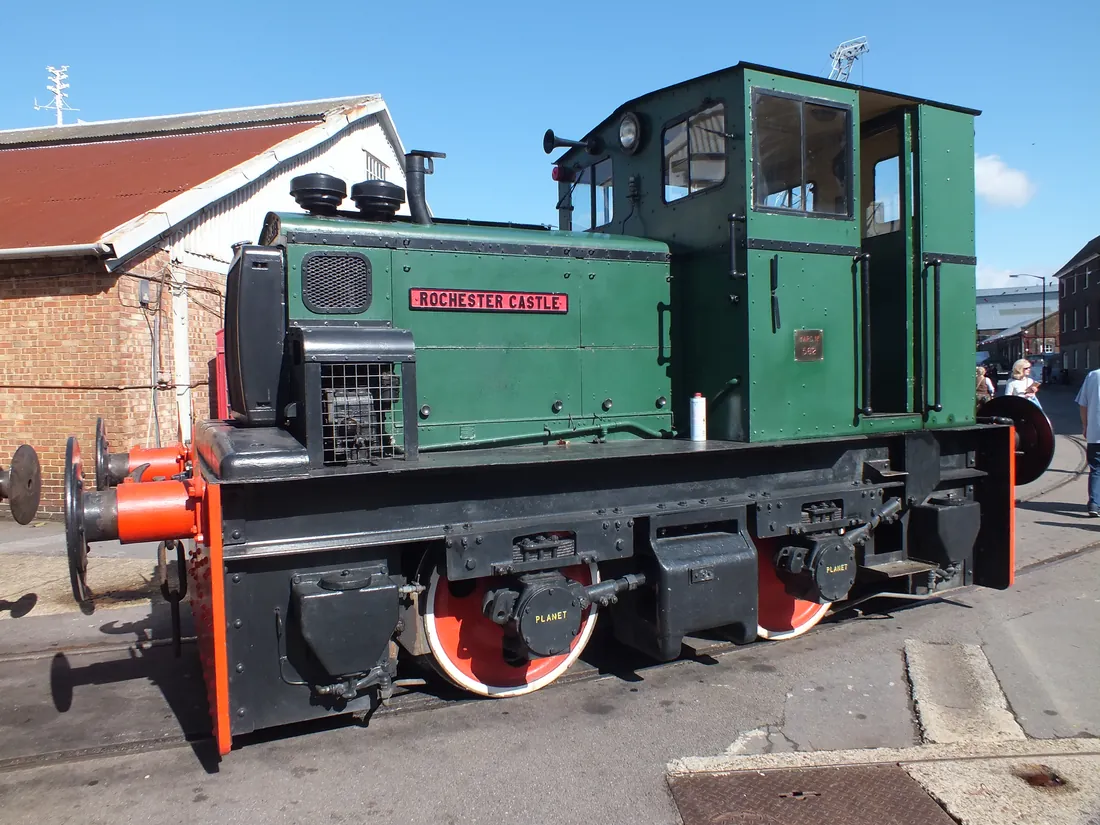
In the early 1950s, the Admiralty began replacing older dockyard and depot locomotives with new diesels. It ordered six standard-gauge Hibberd locomotives for Chatham in 1955, alongside similar Navy Planet variants for other naval sites.
Six-cylinder, two-stroke diesel specified for naval shunters.
Reported rating for the locomotive application.
Reduction stage matched the FD6’s 1,800 rpm to a transmission designed around 1,200 rpm.
Reached with a distinctive front ballast block.
The Foden’s aluminium-alloy crankcase and low magnetic signature were suited to naval use. Chatham’s six castle-named examples—Rochester, Upnor, Leeds, Dover, Cooling and Deal Castle—worked alongside similar Navy locomotives at Devonport, Portsmouth and Rosyth. Narrow-gauge variants served other naval railways.
There is anecdotal evidence that the six Chatham locomotives were delivered with stable doors. These were soon replaced by standard coach doors with opening droplight windows.
The locos were supplied without cab heating. Chatham drivers later fitted coal stoves in the rear corner of the cab, behind the handbrake stanchion. At a later point, radiator-mounted coolant heaters were also retrofitted to keep the engines warm.
The Admiralty specified three warning devices: a 24-volt electric horn, a whistle and an air horn. The whistle and air horn both operated from the locomotive’s main air supply at 100 psi.
The name Upnor Castle was carried by two different Hibberd Planet locomotives, which are easy to confuse. The narrow-gauge Upnor Castle (works no. 3687) was built for the Lodge Hill and Upnor railway. It later worked at the Welshpool & Llanfair Light Railway and the Ffestiniog Railway, and was substantially altered during its preservation career.
Chatham’s Upnor Castle (works no. 3742) was a separate, standard-gauge locomotive, one of six Hibberd diesels delivered new to Chatham in 1955 and named after Kent castles. It remained at the Dockyard until closure in 1984; it was not the narrow-gauge Lodge Hill locomotive.
Sources & further reading
Power ratings, weight figures and transmission details vary between sources and individual builds. Figures here are presented as representative reported specifications. The workshop-floor design story is retained as oral tradition, not established fact.